
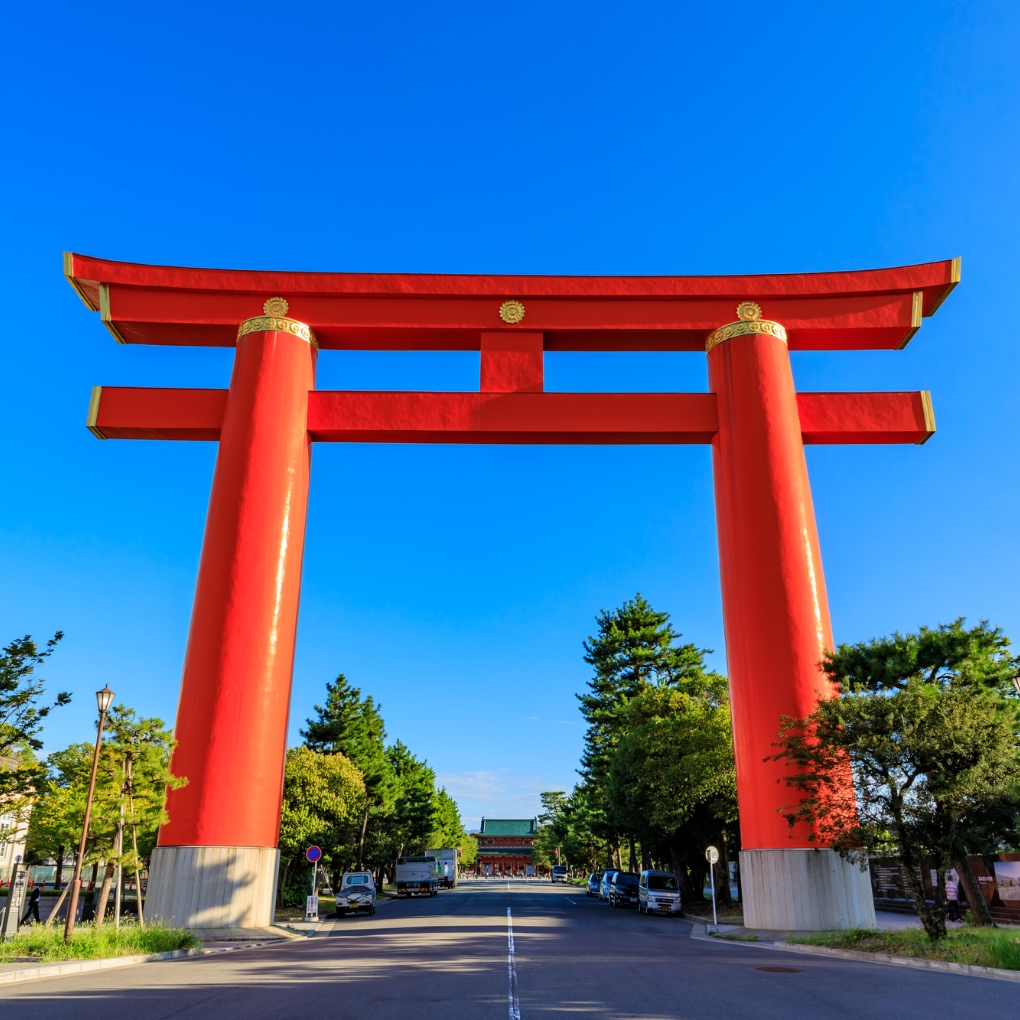
Five rules cover most of it. Bow slightly at a shrine’s torii gate and avoid the middle of the path. Rinse your hands before praying. At a shrine, bow twice, clap twice and bow once; at a temple, press your palms together quietly. Take your shoes off where asked. Do not photograph where signs prohibit it, and never stop, touch or photograph geiko and maiko.
Kyoto adds a few local rules that visitors miss: private lanes in Gion, bamboo carving, drones and eating while walking. They are listed below with their sources.
Step by step: shrines, temples and busy streets
Shrines (jinja) are Shinto and temples (tera) are Buddhist, and the manners differ a little. Choose a tab, or read all three.
At a shrine, such as Fushimi Inari or Heian Jingu
- Bow slightly at the toriiThe gate marks the border between the everyday and the sacred. Many people pause and bow before they pass.
- Keep off the middle of the pathJapan’s national tourism organization advises avoiding the exact centre; a prefectural tourism guide calls it the path of the gods.
- Purify your hands and mouthAt the water basin: rinse your left hand, then your right, rinse your mouth without putting the ladle to your lips, and rinse your left hand again (Jinja Honcho, the association of shrines).
- Offer a coin if you wishThere is no fixed amount. The ¥5 coin tradition is wordplay, not a rule.
- Bow twice, clap twice, pray silently, bow onceThis is the sequence Jinja Honcho and the tourism organization describe for everyone.
- Optional extrasDraw an omikuji fortune, hang an ema wish plaque, or buy a goshuin, a stamp that records your visit with the shrine’s red seal.
Jinja Honcho also discourages food and drink on shrine grounds, asks you not to photograph people without consent and recommends modest dress. For a formal ceremony, long sleeves and trousers or skirts are preferred.
At a temple, such as Kiyomizu-dera or Kinkaku-ji
- Be quiet and dress respectfullyJapan’s tourism organization says temples call for calmer behaviour than shrines.
- Light incense after a small donationWave out the flame with your hand rather than blowing on it.
- Take your shoes off in buildingsWear clean socks, because you will walk in them across wooden and tatami floors.
- Press your palms togetherJoin your hands in silent prayer. Japan’s tourism organization says there is no need to clap.
- Follow the photography signsPhotography is prohibited in parts of temples. Some areas ban flash or all photography.
- Stay on the paths and don’t block themKiyomizu-dera’s own rules also ban drones, monopods and tripods and wedding, cosplay and fashion shoots. Smoking is prohibited, and the temple asks visitors to refrain from eating and drinking outside its cafes and tea houses. Staff may ask violators to leave.
In Gion, Nishiki Market and other crowded streets
- Never stop, touch, follow or photograph geiko or maikoThe district’s joint notice, posted on Kyoto’s tourism site, asks for consent first. They are professionals working, not sights.
- Stay out of private lanes marked closedResidents in Southern Gionmachi announced ¥10,000 fines for photographing on private roads (from October 2019) and for entering narrow private lanes (from April 2024). Hanamikoji-dori itself is a public road. These are news-report sources, so follow the signs.
- Don’t eat while walking in crowded areasKyoto’s tourism site says Nishiki Market strongly discourages it, and Kyoto City asks visitors to avoid it in crowded areas.
- Leave the drone and tripod at homeKyoto’s tourism site says flying drones is prohibited across much of the densely populated city, and tripods block foot traffic.
- Don’t carve or write on bambooKyoto’s tourism site warns that damaging bamboo at the Arashiyama bamboo path risks a penalty of up to ¥300,000.
- Keep the road clearDon’t block roads or walk in wide side-by-side groups.
Do and don’t, at a glance
- Do bow at the torii, rinse your hands, take off your shoes where asked, speak quietly and follow every sign.
- Don’t photograph people without consent, block a path for a photo, use drones or tripods, or climb, touch or carve things.
Penalties listed in Gion’s notice
Gion’s joint notice (December 2023, posted on Kyoto’s tourism site in January 2024) lists penalties under Japanese law. These are legal limits, not what a tourist would typically pay, but they show how seriously the rules are taken.
| What | Penalty listed |
|---|---|
| Obstructing or following someone | Detention of 1 to under 30 days, or a fine of ¥1,000 to under ¥10,000 |
| Trespassing on temple or private property | Up to 3 years’ imprisonment or ¥100,000 |
| Blocking a road | Up to ¥50,000 |
| Littering | Up to ¥30,000 |
| Damage to property | Up to 3 years’ imprisonment or ¥300,000 |
| Touching a person | Up to 6 months or ¥500,000 |
Separately, Kyoto’s tourism site warns that damaging bamboo at Arashiyama risks up to ¥300,000. The ¥10,000 private-road fines mentioned above come from residents’ council announcements, not from this table.
Where each rule applies
| Place | What to remember |
|---|---|
| Kiyomizu-dera | No drones, monopods or tripods, no wedding, cosplay or fashion shoots, no smoking, and no eating or drinking outside its cafes and tea houses. |
| Gion private lanes | No photography on private roads and no entry to lanes marked closed; look for the signs. |
| Nishiki Market | Eating while walking is strongly discouraged; eat at the stall. |
| Arashiyama bamboo path | Don’t carve or write on the bamboo. |
| Everywhere | Follow photography signs, don’t fly drones and don’t block the way. |
Visiting at New Year, when the crowds are enormous? See New Year in Kyoto. Planning your route? Start with the 3-day Kyoto itinerary.
FAQ
Do I clap at a Kyoto temple?
At a shrine, the official instruction is two deep bows, two claps and one bow. At a temple, Japan’s national tourism organization says to join your hands in silent prayer; there is no need to clap.
Is it okay to take photos at temples and shrines?
Outdoors it is generally fine, but photography is prohibited in parts of shrines and temples. Some areas ban flash or all photography, so follow the signs. Jinja Honcho also asks visitors not to photograph people without consent.
Do I need to take my shoes off?
Yes, in temple halls and other buildings where shoes are not allowed. Bring clean socks. Most shrine grounds are outdoors, so the question comes up mainly at temples.
How much should I put in the offering box?
Any amount. Jinja Honcho says there is no fixed amount. The idea that a ¥5 coin is lucky comes from a wordplay on “go-en”, so treat it as a custom, not a rule.
Is photographing geiko and maiko allowed?
Not without permission. The Gion district’s notice asks visitors not to stop, touch, follow or photograph geiko or maiko without consent. Public Kyomai dance shows are the better way to see them.
What is the fine for photographing in Gion’s private lanes?
Local residents’ council notices announced fines of up to ¥10,000 for photographing on private roads in Southern Gionmachi (from 2019) and for entering narrow private lanes marked closed (from 2024). We found these only in news reports, so look for the signs on the spot.
Rules checked 5 October 2026 against Jinja Honcho, Japan National Tourism Organization, the Kyoto Convention & Visitors Bureau, Kyoto City and Kiyomizu-dera’s own FAQ. The ¥10,000 private-lane fines come from news reports.


